

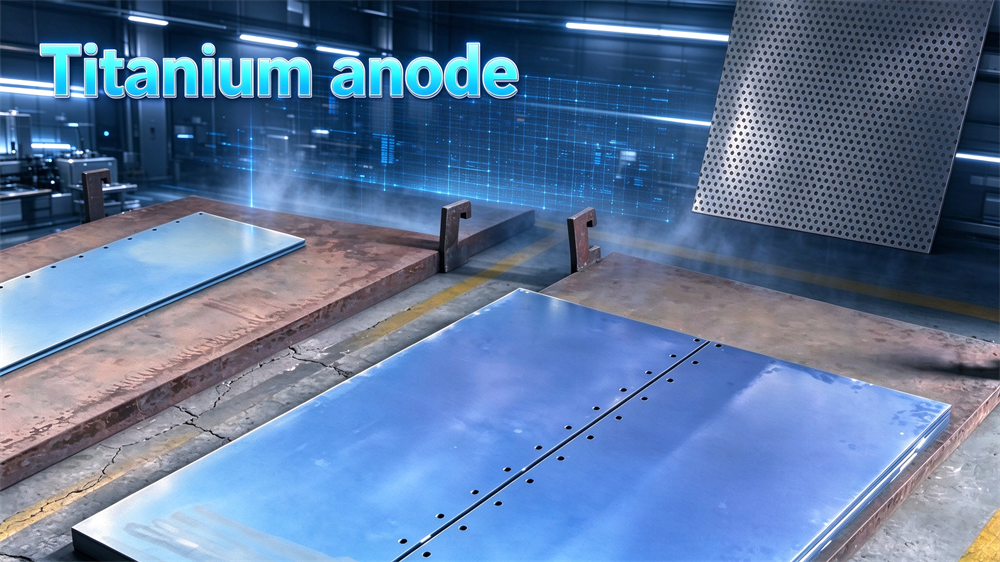
What Is a Titanium Anode? A Complete Guide to Coated Titanium Electrodes
Definition: A titanium anode is an electrode that uses titanium — usually commercially pure grade 1 or grade 2 — as the structural substrate, with a thin catalytic coating of mixed metal oxide or platinum-group metal fired onto its surface. The titanium carries the current and resists corrosion; the coating supplies the electrocatalytic activity. Neither half works alone: uncoated titanium passivates and stops passing current, while a coating without a corrosion-resistant substrate has nothing to sit on. Because the titanium does not dissolve anodically, the electrode keeps its shape for its whole service life — which is why coated titanium anodes are also called dimensionally stable anodes (DSA).
Titanium anode at a glance
| Property | Typical value or specification |
|---|---|
| Substrate | ASTM B338 Grade 1 tube; ASTM B265 Grade 1 strip, sheet or mesh; Grade 2 where strength governs |
| Substrate purity | Commercially pure titanium, ≥ 99.5% Ti |
| Coating families | RuO₂–IrO₂–TiO₂, IrO₂–Ta₂O₅, Pt / Pt–Ir, PbO₂ |
| Coating loading | Typically 4–20 g/m² of noble metal, stated per project |
| Coating thickness | A few micrometres, applied in multiple fired passes |
| Application temperature | 400–600 °C thermal decomposition per pass |
| Operating pH | Roughly 1–12 for standard IrO₂–Ta₂O₅ |
| Service life, electrochemical duty | 3–10 years, set by current density |
| Service life, cathodic protection | 20–40 years at 50–600 A/m² |
| Forms available | Plate, sheet, mesh, expanded mesh, tube, rod, ribbon, wire, disc |
| Alternative name | Dimensionally stable anode (DSA), MMO anode, coated titanium electrode |
What is an anode, in one paragraph
In any electrochemical cell the anode is the electrode where oxidation happens — where the working substance gives up electrons. In an electrolytic cell driven by an external supply, the anode is the positive electrode, and the current leaves the cell through it. That matters practically because the anode sits in the most hostile position in the cell: it is at high positive potential, in contact with an aggressive electrolyte, and it is the place where gas is generated. An anode therefore has to be a conductor, a corrosion barrier and a catalyst at the same time, and it has to keep all three properties for thousands of hours without changing shape.
Most electrode materials are good at one or two of those jobs. Coated titanium is the first family that reliably does all three.
Why titanium — and why not bare titanium
Titanium earns its place for reasons that have nothing to do with catalysis.
- It passivates. In air or water, titanium instantly grows a coherent oxide film a few nanometres thick. That film is the reason the metal is effectively inert in seawater, chloride brines, hypochlorite, and many acids.
- It is light and strong. Density around 4.5 g/cm³ — about 40% of lead's — with the mechanical strength of a structural metal. Anodes can be thin, large, and handled without damage.
- It is formable. Sheet, mesh, expanded mesh, tube, rod, ribbon and wire are all routine. The geometry can follow the cell instead of the cell being designed around the electrode.
- It is available and consistent. Commercially pure grade 1 and grade 2 are standard mill products with published compositions and mechanical properties, so a specification can be written and verified.
The catch: bare titanium is a poor anode
That same passive film is an electrical insulator. Drive an uncoated titanium electrode anodically and the oxide thickens; the anode potential climbs steeply, current collapses, and the electrode stops working. This is not a slow degradation — it is a fairly abrupt failure of the electrode as an electrode.
Which produces the single most useful distinction in this field:
Titanium is an excellent cathode and a poor anode. The coating is what turns it into an anode.
That is why the same metal appears on both sides of a cell in different roles. Bare titanium is the standard material for titanium cathodes in electroplating and electrowinning, where its passivity is an asset because the cathodic reaction does not require it to dissolve. On the anode side, the coating supplies the missing property: an electronically conductive, catalytically active oxide that is itself stable at high anodic potential.
Coating types: matching the oxide to the reaction
The coating decides what the anode does well. Four families cover almost all industrial duty.
| Coating system | Reaction it is built for | Electrolyte | Typical use |
|---|---|---|---|
| RuO₂–IrO₂–TiO₂ | Chlorine evolution (CER) | Brine, seawater, hypochlorite | Chlor-alkali, seawater electrochlorination, pool salt cells |
| IrO₂–Ta₂O₅ | Oxygen evolution (OER) | Acid sulphate, fresh water, soil | Copper, zinc and nickel electrowinning, plating, wastewater oxidation |
| Pt / Pt–Ir on Ti, Nb or Ta | Chlorine evolution, high-purity duty | Seawater, chrome plating baths, ionised water | Platinised titanium electrodes, PEM hydrogen electrolysis |
| PbO₂ on titanium | Oxygen evolution at high potential | Sulphate, oxidant generation | Lead dioxide coated titanium anodes where a high O₂ overpotential is the requirement |
What each element actually does
Coating formulations are proprietary, but the functional roles are not.
Ruthenium is the activity engine for chlorine evolution. RuO₂ has the lowest chlorine overpotential of the common oxides, which is why the ruthenium-coated titanium anode displaced graphite in the chlor-alkali industry within a decade of its introduction in the 1960s. Its weakness is solubility when oxygen is being evolved.
Iridium is the stability engine. IrO₂ holds up under oxygen evolution and high anodic potential, and it is the basis of nearly every acid-service coating.
Tantalum is a stabiliser, not a catalyst. It raises resistance to acid attack and slows iridium dissolution, which is why IrO₂–Ta₂O₅ became the default for oxygen-evolution and low-pH duty.
Titanium in the coating adjusts structure and cost; it is not there for activity.
Platinum brings its own electrochemistry and, in thin layers, its own failure mode — see below.
Why coating adhesion decides the specification
A coating is only as good as its bond. Coating loss in service almost never happens by uniform wear; it happens where the bond was weak, where loading was uneven, or where handling damage breached the layer. Three process variables control this, and none of them appear in a headline datasheet: surface roughness from etching, pass-to-pass uniformity of precursor loading, and total noble-metal loading in g/m². Thickness in micrometres is not a comparable figure between suppliers, because porosity and phase composition differ; loading in g/m² is the number that maps to charge capacity.
How a titanium anode works
The electrode does two jobs simultaneously, and it is worth separating them.
The substrate carries current and holds geometry. Titanium conducts, and because it passivates rather than dissolves, its dimensions do not change. Anode-to-cathode spacing stays where it was designed, so cell resistance stays flat and current distribution across the electrode face does not drift. This is the entire meaning of "dimensionally stable".
The coating catalyses the reaction and protects the substrate. The oxide layer lowers the activation energy of the anodic reaction, so gas is evolved at low overpotential, and it physically separates the titanium from the electrolyte so the substrate is never asked to survive anodic conditions directly.
The reactions that matter
| Environment | Anodic reaction | Coating that fits |
|---|---|---|
| Brine / high chloride | 2Cl⁻ → Cl₂ + 2e⁻ | RuO₂-based |
| Water, acid, sulphate | 2H₂O → O₂ + 4H⁺ + 4e⁻ | IrO₂-based |
| Hypochlorite generation | Cl⁻ + 2OH⁻ → ClO⁻ + H₂O + 2e⁻ | RuO₂ / Ru–Ir |
| Seawater | Cl₂, hydrolysing to HOCl / ClO⁻ | Ru–Ir |
| Chloride plus oxygen co-evolution | Both reactions at the same face | Ir–Ru–Ti bifunctional, or IrO₂–Ta₂O₅ |
Where both gases are produced, the coating has to be chosen from the measured gas ratio, not from preference. A Ru-rich coating in an oxygen-dominated environment will lose ruthenium; an Ir-only coating in a chlorine-dominated one gives away efficiency for stability it does not need.
Overpotential, in one line
Overpotential is the voltage above the thermodynamic requirement that the electrode actually needs. It is pure loss — it appears on the rectifier's meter and produces nothing. Coated titanium anodes are specified precisely because they hold that loss low: in chlorine evolution, RuO₂-based coatings are commonly credited with 300–500 mV lower overpotential than the graphite and lead anodes they replaced, and the energy consequence of that gap is set out in the comparison of MMO and traditional anode materials.
How a coated titanium anode is manufactured
The process, not the recipe, separates a ten-year anode from a three-year one.
| Step | Operation | Why it decides the outcome |
|---|---|---|
| 1. Substrate forming | Cut, weld, bend or expand the titanium into plate, mesh, tube, rod or ribbon | Weld quality and edge condition set where coating defects will later appear |
| 2. Surface preparation | Degrease, then mechanical abrasion, then hot-acid etch to a rough, oxide-free surface | Adhesion depends entirely on this; a smooth or contaminated surface produces a coating that debonds rather than wears out |
| 3. Precursor application | Apply dissolved metal salts by brush, dip or spray in many thin, even passes | Uneven loading creates current-density hot spots, and the coating fails first where it is thinnest |
| 4. Thermal decomposition | Fire each pass at roughly 400–600 °C, converting salts into crystalline oxides | Under-firing leaves soluble, unconverted phases; over-firing coarsens the structure and loses surface area |
| 5. Repeat to loading | Cycle steps 3–4 until the specified noble-metal loading in g/m² is reached | Loading is what maps to charge capacity, and therefore to life |
| 6. Anneal and inspect | Final anneal, then integrity, adhesion and conductivity checks | Defects caught here do not become field failures |
Verification is part of the specification, not an administrative extra. Bend testing for adhesion, X-ray or equivalent inspection for coating integrity, and accelerated life testing for charge capacity are what convert a catalogue claim into a number a plant can design against. The regime behind the product is documented in the quality system and certification and compliance pages.
Forms of titanium anode
The same coating performs differently depending on how it is presented to the electrolyte, so geometry is a technical choice, not a packaging one.
| Form | Typical section | Why it exists | Typical duty |
|---|---|---|---|
| Plate / sheet | 0.5–3 mm | Large flat active area, easy to space in a tank | Electrowinning, plating, electrochlorination cells |
| Expanded mesh | 0.5–2 mm | High area per unit volume, low gas blinding, good current uniformity | Plating baskets, water treatment, electrochlorination |
| Tube | Ø16–32 mm × 500–1500 mm | Compact high-output element, suits strings and bores | Deep well groundbeds, ICCP |
| Rod | Ø3–25 mm | Rigid, simple mounting | Water heaters, small cells, CP |
| Ribbon | 6.35 / 12.7 mm × 0.6–0.9 mm | Line source distributes current evenly over flat areas | Tank bottoms, concrete, pipe trenches |
| Wire / linear | Ø1.5–3 mm | Follows irregular geometry in long continuous runs | Congested pipework, internal surfaces, rehabilitation |
| Disc | Circular assembly | Flush mounting through a hull or seawater box | Marine ICCP |
The form ranges are browsable under titanium mesh, titanium plate/sheet and titanium tube, and the ICCP-specific geometries under MMO tubular, MMO ribbon, MMO wire and MMO disc anodes.
Advantages, stated with their limits
| Advantage | What it means in practice | The limit beside it |
|---|---|---|
| Corrosion resistance | Effectively inert from about pH 1 to pH 12, in chloride, seawater and many acids | Below pH 1 the substrate itself is at risk; fluoride attacks titanium regardless of coating |
| Dimensional stability | Gap and cell resistance flat for life; no voltage creep | Only while the coating is intact — a fully spent coating loses the anode |
| High current density | Thousands of A/m² in electrochemical plant; 600 A/m² in seawater CP | Life falls in proportion to current density |
| Low overpotential | Lower cell voltage, lower kWh per tonne | Depends on matching the coating to the gas evolved |
| Weight and formability | ~40% of lead's density; can be formed to the cell | Thin sections are vulnerable to handling damage |
| No contamination | No lead, no carbon, no sludge into product or effluent | Recoating and stripping still generate process waste |
| Recoatability | Substrate is reusable at end of coating life | Requires a competent strip-and-recoat supply chain |
Where titanium anodes are used
| Sector | Duty | What the anode is doing |
|---|---|---|
| Water treatment and disinfection | Electrochlorination, electro-oxidation, electrocoagulation | Generating chlorine or hydroxyl radicals in situ; must not contaminate the treated water. See ammonia removal and landfill leachate treatment |
| Chlor-alkali | Brine electrolysis | Producing chlorine and caustic at high current density with stable cell voltage |
| Electroplating and surface finishing | Copper, nickel, chrome, PCB plating | Uniform current distribution, insoluble anode so bath chemistry stays stable |
| Electrowinning and refining | Copper, zinc, nickel, cobalt | Oxygen evolution in hot acid without lead contamination of the cathode |
| Cathodic protection | ICCP groundbeds, tank bottoms, hulls | Delivering current for decades at low current density — see ICCP and MMO anodes |
| Electrodialysis and ionised water | Membrane stack electrodes | Reversing polarity without rapid coating loss — see electrodialysis anodes |
| Hydrogen and emerging duty | PEM and alkaline electrolysis, organic electrosynthesis, advanced oxidation | Low OER overpotential at the highest anodic potentials in industry |
What limits a titanium anode
An honest guide names the failure modes, because they are what a specification has to design around.
Noble-metal cost. Iridium and ruthenium loading is the price driver, and iridium price volatility is a genuine procurement risk. It is also why "more coating" is not automatically the right answer — the question is charge capacity per gram, not grams per square metre in isolation.
The coating is the single point of failure. The substrate is essentially permanent; the coating is not. Handling damage, uneven loading, or a poorly etched surface will end the anode's life long before its calculated capacity is spent.
Cathodic polarity destroys the coating. If the electrode is driven cathodic — by reverse polarity, a rectifier fault, or a stray current path — the oxide is reduced and lost quickly. Protection against reverse polarity is part of the anode specification, not an operational nicety.
Fluoride attacks titanium. Even a well-coated anode is at risk where free fluoride is present, because fluoride attacks the titanium substrate through coating defects. This is a chemistry constraint, not a coating-quality issue.
Strong acid below pH 1 needs a different substrate. Tantalum or niobium, not thicker oxide.
Not every electrolyte suits titanium at all. Molten-salt systems and some specialty chemistries remain the domain of graphite or other materials. A supplier who will not say so is not specifying, only selling.
How to specify a titanium anode
Six criteria settle almost every enquiry.
- Electrolyte and pH. Composition, chloride level, fluoride presence, temperature. This alone narrows the coating family.
- Gas evolved at the anode, and its ratio. Chlorine-dominant takes Ru; oxygen-dominant takes Ir. Mixed duty needs the ratio, not a preference.
- Design current density. It sets throughput and it sets life. Above roughly 500–1,000 A/m² coated titanium is the only realistic electrode family.
- Required service life, converted to charge capacity. Life = capacity ÷ (current density × 8,760). Working backwards from the required years gives the loading to specify.
- Form factor and cell geometry. Plate, mesh, tube, rod, ribbon or wire — and the space, flow and gas-release path around it.
- Rectifier and polarity protection. Voltage and current limits, plus what happens on shutdown, reverse polarity or a fault.
Get those six right and the quotation is a specification. Omit them and it is a price.
How long does a titanium anode last?
Life is a division, not an opinion:
Life (years) = Coating charge capacity (A·h/m²)
               ÷ [ Design current density (A/m²) × 8,760 h/year ]
A coating qualified at 4 × 10⁷ A·h/m² driven at 500 A/m² yields about nine years; the same coating at 1,000 A/m² yields about four and a half. At cathodic-protection current densities of 50–600 A/m² the same arithmetic returns 20–40 years, which is why CP anodes are quoted in decades and electrochemical anodes in years. Both are correct — they are simply different divisors.
At end of life the anode is stripped, re-etched and recoated. The titanium survives, so the second and third coating cycles cost a fraction of a new electrode and consume a fraction of the material.
Where titanium anode technology is heading
From loading to structure. Adding noble metal raises capacity and cost together. Development has moved to microstructure, doping and phase control to raise activity per gram — which is why the meaningful metric is shifting from g/m² of coating to A·h per gram of iridium.
Iridium thrift in oxygen evolution. PEM water electrolysis is now the strongest single driver: the anode operates at low pH, high potential and continuous oxygen evolution, and it is the stack's efficiency bottleneck. Coatings that hold low OER overpotential for tens of thousands of hours at reduced iridium loading are the active research front.
Selectivity rather than raw activity in chlorine evolution. Raising CER activity is no longer the hard part; suppressing oxygen co-evolution at high current density is. That trade-off drives most Ru-system development.
Recoating as the default end of life. As substrate value and lead times rise, strip-and-recoat becomes standard practice rather than a fallback, which turns the anode into a maintainable asset and changes how it should be depreciated.
Electrode plus cell, not electrode alone. Anode area, cell geometry and rectifier rating are interdependent, and mismatch between them is a common reason a well-specified electrode underperforms. That is why supply increasingly includes electrolytic cells and packaged generator systems.
Condition monitoring. Coating degrades gracefully and invisibly. Per-element cell voltage and reference-potential trending are becoming part of the anode package rather than an afterthought, because they are the only way to see end of life coming.
FAQ: titanium anodes
What is a titanium anode made of?
Two parts. A substrate of commercially pure titanium — usually ASTM B338 Grade 1 tube or ASTM B265 Grade 1 sheet, strip or mesh — and a catalytic coating of mixed metal oxide or platinum-group metal, fired on in multiple passes to a few micrometres. The substrate carries current and resists corrosion; the coating provides the electrocatalytic activity.
Is a titanium anode positive or negative?
In an electrolytic cell the anode is the positive electrode, and that is where a coated titanium anode operates. The distinction matters because the electrode is not reversible: driven cathodic, the oxide coating is reduced and lost quickly. Polarity protection belongs in the specification.
Is DSA the same as a titanium anode?
Largely, yes, in industrial usage. DSA stands for dimensionally stable anode, a term coined for the ruthenium-oxide-coated titanium anode that replaced graphite in chlor-alkali cells from the 1960s. Almost all DSAs are coated titanium. The reverse is not automatic — a platinised titanium electrode is a coated titanium anode, but "DSA" is normally used for the mixed-oxide family.
Can titanium be used as an anode without a coating?
Not usefully. Bare titanium passivates: the oxide film that makes it corrosion-resistant is also an electrical insulator, so under anodic polarity the potential climbs and current collapses. Uncoated titanium is widely used — as a cathode, where passivity is an advantage. The coating is what makes the same metal function as an anode.
Which titanium grade should an anode use?
Grade 1 for most anode substrates: lowest impurity level, best corrosion resistance and formability. Grade 2 where mechanical strength governs, for example long unsupported tube spans or structural assemblies. Both are specified in ASTM B338 for tube and ASTM B265 for strip, sheet and plate, so the requirement can be written and verified against a mill certificate.
What is the difference between a titanium anode and a titanium cathode?
The same material in opposite polarity, with opposite requirements. As a cathode, titanium needs only to conduct and survive; its passive film is helpful. As an anode it needs a catalytic surface that is stable at high positive potential, which is exactly what a bare passive film is not. That is why titanium cathodes are used uncoated and titanium anodes are always coated.
Why do titanium anodes reduce energy consumption?
Because the coating lowers the overpotential of the gas-evolving reaction, and overpotential is voltage the plant pays for and never uses. In chlorine evolution, RuO₂-based coatings are commonly credited with 300–500 mV lower overpotential than the graphite or lead anodes they replaced. Multiplied across a cell current and a year of operating hours, that gap is usually the largest single number in the anode business case.
What kills a titanium anode early?
In practice, five causes account for most premature failures: coating damage during handling or installation; being driven above its design current density; uneven coating loading creating local hot spots; a poorly etched substrate giving weak adhesion; and loss of polarity protection. Manufacturing defects exist, but field and specification errors are far more common.
Can a titanium anode operate in seawater?
Yes, and seawater is one of its strongest applications — both for electrochlorination, where a Ru–Ir coating evolves chlorine, and for marine cathodic protection, where disc and tubular anodes operate at up to about 600 A/m². The high chloride level that destroys graphite and lead-based anodes is exactly what titanium is passive against.
What temperature can a titanium anode withstand?
Most aqueous electrochemical duty runs below about 80–90 °C, and standard coatings are specified within that range. Above it, coating degradation accelerates and the effect has to be built into the life calculation rather than assumed away. The firing step during manufacture reaches 400–600 °C, but that is a process condition, not an operating one.
Can a titanium anode be repaired or recoated?
Recoated, yes: the substrate is chemically stripped, re-etched and re-coated, returning to service with fresh charge capacity at a fraction of the cost of a new electrode. Repaired, usually no — a breached coating area cannot be re-formed in the field to the same integrity, so the practical options are to replace the element or accept the reduced active area.
What is the difference between an MMO and a platinised titanium anode?
The catalytic layer. MMO anodes use mixed oxides — ruthenium, iridium, tantalum, titanium — fired onto the substrate, and generally offer more charge capacity per unit cost at industrial current densities. Platinised anodes use a thin platinum layer and suit high-purity, small-area and specialty duty where platinum's electrochemistry is required. The choice is a question of duty, not of quality.
Standards and references
- ASTM B338 — Standard Specification for Seamless and Welded Titanium and Titanium Alloy Tubes for Condensers and Heat Exchangers
- ASTM B265 — Standard Specification for Titanium and Titanium Alloy Strip, Sheet and Plate
- ASTM B348 — Standard Specification for Titanium and Titanium Alloy Bars and Billets
- ISO 19097-1 — Accelerated life test method for mixed metal oxide anodes: Part 1, anodes in concrete
- ISO 19097-2 — Accelerated life test method for mixed metal oxide anodes: Part 2, anodes in soils and natural waters
- NACE TM0108 — Testing of Catalyzed Titanium Anodes for Use in Soils or Natural Waters
- NACE SP0572 — Design, Installation, Operation and Maintenance of Impressed Current Deep Anode Beds
- DNV-RP-B401 — Cathodic Protection Design
Summary
A titanium anode is a titanium substrate carrying a catalytic oxide coating. The substrate contributes corrosion resistance, mechanical strength and dimensional stability; the coating contributes electrocatalytic activity and protects the substrate from direct anodic attack. Together they produce an electrode whose geometry and cell resistance stay flat for years, which is why coated titanium displaced graphite and lead across chlor-alkali, electrochlorination, electrowinning, plating, water treatment and cathodic protection.
Getting it right comes down to matching four variables: substrate grade, coating chemistry, noble-metal loading, and form factor — against the electrolyte, the gas evolved, the design current density and the required life.
Talk to an electrode engineer
Xi'an AUE Technology Co., Ltd. manufactures electrocatalytic titanium anodes — ruthenium-iridium, iridium-tantalum, ruthenium oxide, platinised and lead dioxide coatings on ASTM B338 and ASTM B265 Grade 1 titanium — in plate, mesh, tube, rod, ribbon, wire and disc formats, together with electrolytic cells and sodium hypochlorite generation systems. Twenty-one years in electrochemical electrode materials, ISO 9001 quality management, and supply to projects in more than 120 countries.
Coating adhesion, coating integrity and charge capacity are qualified by bend testing, X-ray inspection and accelerated life testing before shipment, so the life figure attached to a project is tied to a measured result rather than a catalogue assumption.
Send your electrolyte composition and pH, the gas evolved at the anode, design current density, required service life, operating temperature and cell geometry, and we will confirm the substrate grade, coating system, loading and form factor. Contact our engineers, or browse the FAQ for shorter answers.