

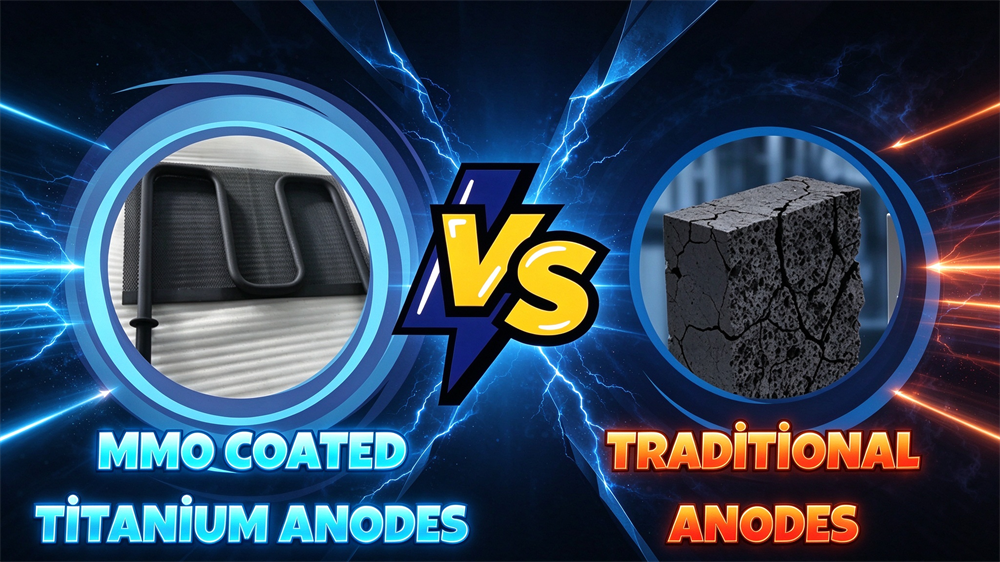
MMO Coated Titanium Anodes vs Traditional Anodes: A Selection Guide for Electrochemical Plant
Short answer: Choose an MMO coated titanium anode when the cell runs continuously at meaningful current density and you intend to keep it closed for years. The reason is not that the coating is exotic — it is that a titanium substrate passivates and holds its dimensions, so the anode stops being a consumable and the cell voltage stops drifting. Graphite and lead-based anodes both work by being consumed, which puts a clock on the cell and a rising resistance into the power bill. The genuine exceptions are narrow: molten-salt duty, low-current non-critical chemistry, and high-oxygen-overpotential service where lead dioxide is doing a job no MMO coating replicates cheaply.
What this guide decides
There are four anode material families in industrial use. Most procurement decisions come down to choosing between them on price, and that is the wrong axis — price per anode is a small number next to the electricity the anode will consume.
| Family | How it supplies current | What ends its life | Where it still belongs |
|---|---|---|---|
| Graphite | Is consumed electrochemically | Mass loss and dimensional change | Molten salt, low-current legacy chemistry |
| Lead / PbO₂ (lead substrate) | Is consumed slowly | Coating loss plus lead contamination | Niche high-OER duty with tolerance for lead |
| PbO₂ coated titanium | Catalytic coating on inert substrate | Coating wear only | High oxygen overpotential duty, oxidant generation |
| Platinum (solid or clad) | Catalytic surface | Substrate passivation through a thin layer | High-purity, small-area, high-value cells |
| MMO coated titanium (DSA) | Catalytic coating on inert substrate | Coating charge capacity exhausted | Chlor-alkali, electrochlorination, electrowinning, plating, water treatment, CP |
Note the distinction that is usually blurred in supplier literature: "lead dioxide anode" and "lead dioxide coated titanium anode" are different products. The first is a lead-based body that is consumed; the second is an inert titanium substrate carrying a PbO₂ catalytic layer. The second solves the dimensional-stability problem. It does not solve the lead problem. Both statements matter, and they point in different directions for different plants — see the lead dioxide coated titanium anode range for where that trade-off is deliberate.
Three numbers that decide the specification
Everything else in an anode datasheet is downstream of these three.
1. Overpotential (η). The extra voltage above the thermodynamic decomposition potential that the electrode actually needs. It is loss. It appears on the kWh meter and produces no product.
2. Design current density (A/m²). Production rate per unit of electrode area. It sets how compact the cell can be — and, for any coated anode, it sets how fast the coating is spent.
3. Coating charge capacity (A·h/m²). The total charge a coating can pass before its potential rises past an agreed failure criterion, measured by accelerated life test. Divide by the current density and you have the life.
Graphite offers no third number, because it has no coating: its life is mass divided by consumption rate. That is why graphite quotations are simple and graphite operating costs are not.
Where the anode's overpotential actually sits in the cell voltage budget
The single most useful thing a buyer can do is ask where the anode sits inside the total cell voltage. A membrane chlor-alkali cell running near 3.0 V is not 3.0 V of chemistry — most of it is losses, and only one of them is the anode's.
| Voltage component | Indicative contribution | Set by |
|---|---|---|
| Thermodynamic decomposition potential | ~2.2 V | Chemistry — cannot be engineered away |
| Anode overpotential (CER) | 0.05–0.15 V on DSA; materially higher on graphite | Anode coating |
| Cathode overpotential (HER) | 0.10–0.25 V | Cathode activation |
| Membrane / diaphragm resistance | 0.25–0.40 V | Separator, electrolyte concentration |
| Electrolyte, gas bubble and busbar losses | 0.15–0.30 V | Cell design and hydraulics |
Indicative apportionment for a membrane cell; actual values depend on cell design, brine quality and temperature. The point is structural: the anode is not the largest loss in the cell, but it is the loss you can change by changing one component without rebuilding the plant. That is why anode upgrades pay back faster than most efficiency projects.
Failure mechanisms, material by material
Specification arguments are won on failure modes, not on headline properties.
Graphite: the anode is the feedstock
In brine service graphite is oxidised at the surface and along grain boundaries. Carbon leaves as CO₂ and as surface oxides; the body genuinely shrinks. Two costs follow immediately.
The anode-to-cathode gap widens, so the ohmic resistance of the cell rises. The current distribution across a wide electrode face becomes uneven, which shows up as local hot bands and inconsistent product. And the rectifier has to hold current against a resistance that did not exist at commissioning.
The second cost is the maintenance cycle. A graphite anode in aggressive chlorine duty is replaced on a cycle measured in months, and each replacement is a cell opening: cool down, drain, purge, disassemble, clean, re-gasket, leak test, recommission. The anode invoice is the smallest line in that sequence.
Lead and lead dioxide: the contamination constraint
PbO₂ has one genuine electrochemical advantage — a high oxygen-evolution overpotential — and it is stable in strong sulphuric acid. That combination is why it dominated copper electrowinning for decades.
The problems are not electrochemical.
- Lead is regulated. Occupational exposure controls during handling and machining, and hazardous-waste classification at end of life, are both permanent overheads.
- The coating reports to the product. In electrowinning, lead that reaches the cathode is a purity failure. In water treatment it is a discharge compliance failure.
- Sludge is a recurring cost. Spalled coating accumulates in the electrolyte and must be filtered, analysed and disposed of — a cost that never appears on the anode quotation.
- Current density is capped by coating adhesion to its substrate, well below what a coated titanium DSA tolerates.
Putting the PbO₂ layer on titanium fixes the third and fourth points and leaves the second entirely intact. That is the honest description of the trade-off.
Platinum: the economics of a thin layer
Solid platinum is corrosion-proof and electrocatalytically sound, and priced accordingly. It is only rational in small, high-value, high-purity cells — pH measurement, specialty oxidant generation, some medical and analytical duty.
At larger scale platinum is deployed as a thin coating or clad on titanium, niobium or tantalum. That is where the failure mode lives: once the layer is thin, mechanical damage breaches it, the substrate beneath passivates, contact resistance climbs sharply, and the anode dies with most of its platinum still in place. Platinised titanium remains an excellent answer for hard chrome plating and similar duties where it replaces lead with a dimensionally stable surface — but its economic window is defined by coating thickness and current density, not by corrosion resistance.
The pattern behind all three
Every legacy family imposes the same operating discipline: compensate with voltage, compensate with maintenance, compensate with replacement. The cost never appears on the anode purchase order. It appears in the electricity bill and the production schedule.
Anatomy of an MMO coated titanium anode
An MMO anode — mixed metal oxide anode, coated titanium anode, DSA — is a two-material composite, and the split of duties is the whole design.
Substrate: titanium, for the passive film
The substrate is unalloyed titanium: ASTM B338 Grade 1 tube, ASTM B265 Grade 1 strip, sheet or expanded mesh, with Grade 2 where mechanical strength governs. It is selected for one property — it passivates. A thin, self-repairing oxide film forms on contact with water or oxygen and renders the metal effectively inert across a wide range of aggressive electrolytes.
Two consequences follow, and both are commercial.
The substrate does not dissolve anodically, so the anode's dimensions are fixed for life. Cell resistance stays where it was designed, and the current distribution across the electrode face does not drift.
The passive film is also a safety net. If the coating is breached, exposed titanium re-passivates within seconds rather than corroding. A damaged anode loses output at that spot; it does not lose the substrate, and it does not fail catastrophically mid-campaign.
Coating: three families, three reactions
The catalysis lives in a few micrometres of fired noble-metal oxide. Which family you specify is decided by which gas the electrolyte produces at the anode.
| Coating | Reaction it is built for | Typical duty on this site |
|---|---|---|
| RuO₂–IrO₂–TiO₂ | Chlorine evolution (CER) | Chlor-alkali brine electrolysis, seawater electrochlorination, hypochlorite generation |
| IrO₂–Ta₂O₅ | Oxygen evolution (OER), or mixed OER/CER | Copper electrowinning, zinc and nickel electrowinning, electroplating, electrochemical oxidation of wastewater |
| Pt / Pt–Ir on Ti, Nb or Ta | Chlorine evolution, high-purity duty | Platinised titanium electrodes, chrome plating, ionised-water electrolysis |
The minor oxides are functional, not filler. Tantalum stabilises the coating in acid and slows iridium dissolution at high anodic potential — which is why IrO₂–Ta₂O₅ is the default for acid and oxygen-evolution duty. Ruthenium raises activity but dissolves more readily when oxygen is evolved, so Ru-rich coatings are reserved for chlorine-dominated service. Titanium in the coating adjusts structure and cost.
The interface is where life is actually decided
Two suppliers can quote "IrO₂–Ta₂O₅, 8 g/m²" and deliver anodes that differ by a factor of two in service life. The difference sits in three places that no datasheet headline captures:
Surface preparation. Mechanical abrasion followed by hot-acid etching produces a rough, oxide-free surface. A smooth or contaminated surface produces a coating that debonds in service rather than wearing out.
Pass per pass uniformity. Precursor is applied by brush, dip or spray in many thin passes, each fired at roughly 400–600 °C to convert the metal salts into crystalline oxide. Uneven loading creates local current-density hot spots, and the coating fails first exactly where it is thinnest.
Total loading in g/m² of noble metal. This is the specification that maps to charge capacity. Thickness in micrometres is not comparable between suppliers, because porosity and phase composition differ; loading is.
That is why third-party or in-house verification matters more than the coating recipe. The quality system behind an anode, and the certification and compliance documentation around it, are part of the technical specification rather than an administrative afterthought.
Calculating service life, and verifying the claim
An MMO anode does not supply current by dissolving. It supplies current by catalysing a reaction, and the coating is spent by electrochemical dissolution and detachment at its surface. Life is therefore a division:
Life (years) = Coating charge capacity (A·h/m²)
               ÷ [ Design current density (A/m²) × 8,760 h/year ]
Worked example. A plate anode with 0.5 m² of coated area carrying 250 A runs at 500 A/m². A coating qualified at 4.0 × 10⁷ A·h/m² gives:
4.0 × 10⁷ ÷ (500 × 8,760) ≈ 9.1 years
Run the same plate at 1,000 A/m² and the answer halves. Nothing about the anode changed; only the duty did. This is why two plants can quote completely different lives for the same product and both be telling the truth.
The capacity figure itself must come from a test, not a catalogue. ISO 19097-2 covers accelerated life testing of MMO anodes in soils and natural waters, ISO 19097-1 covers anodes in concrete, and NACE TM0108 is widely used for accelerated testing of catalytic anode coatings. A defensible life claim names four things together: the coating loading, the test method and result, the design current density, and the electrolyte. Missing any one turns a specification into an estimate.
The cost model that actually persuades a plant manager
Purchase price comparisons between anode materials are close to meaningless, because the anode is a minority of the cost of owning a cell. The model that survives a capital committee is cost per tonne of product.
Step 1 — convert overpotential into specific energy
For chlorine, the specific charge is fixed by Faraday's law:
Charge per tonne Cl₂ = (2 × 96,485 C/mol) ÷ 70.9 g/mol
                     = 2,722 C/g
                     = 756 kA·h per tonne

Specific energy (kWh/t) = 756 × cell voltage (V)
At 3.20 V that is 2,419 kWh per tonne; at 2.95 V it is 2,230 kWh per tonne. A 250 mV reduction is worth about 189 kWh per tonne of chlorine, before any change in maintenance.
Step 2 — scale to plant output
| Voltage reduction | Energy saved (kWh/t Cl₂) | 50,000 t/yr @ $0.09/kWh | 100,000 t/yr @ $0.09/kWh | 200,000 t/yr @ $0.09/kWh |
|---|---|---|---|---|
| 100 mV | 76 | ~$0.34 M/yr | ~$0.68 M/yr | ~$1.36 M/yr |
| 200 mV | 151 | ~$0.68 M/yr | ~$1.36 M/yr | ~$2.72 M/yr |
| 300 mV | 227 | ~$1.02 M/yr | ~$2.04 M/yr | ~$4.08 M/yr |
| 400 mV | 302 | ~$1.36 M/yr | ~$2.72 M/yr | ~$5.44 M/yr |
Energy-only, at a stated power price. Substitute your own cell voltage, tariff and tonnage — the arithmetic is two multiplications, and it is the fastest way to settle an anode argument.
Step 3 — add the costs that never reach the quotation
| Cost line | Graphite | PbO₂ on lead | Pt-clad | MMO titanium |
|---|---|---|---|---|
| Anode purchases over 10 years | Many | Several | One to two | One, plus one recoat |
| Cell openings | Many | Several | Few | Few |
| Labour per opening | Modest | Modest plus lead controls | Modest | Modest |
| Lost production per opening | The dominant number | The dominant number | Lower | Lowest |
| Waste stream | Carbon scrap | Hazardous lead waste | Platinum recovery | Recoatable substrate |
| Coating end of life | n/a | Coating spent | Substrate passivated | Recoated |
Two lines carry the argument. Lost production rarely appears in an engineering comparison and almost always dominates the financial one. Recoating changes the shape of the curve entirely: the titanium substrate survives, so the second and third coating cycles cost a fraction of a new anode and consume a fraction of the material.
Step 4 — state the assumption you are least sure of
Every model has one. Here it is the power price and the annual hours. Run the model at 4,000 h/yr instead of 8,000 and every energy number in the table above halves; the ranking between materials does not change, but the payback period roughly doubles. Say that out loud in the business case and nobody will challenge the conclusion.
Selection matrix: matching material to duty
| Duty | Recommended | Why | Do not use |
|---|---|---|---|
| Chlor-alkali brine electrolysis, high current density | RuO₂–IrO₂–TiO₂ on Ti | Lowest CER overpotential; dimensionally stable at high current density | Graphite — consumed, gap drifts |
| On-site hypochlorite / seawater electrochlorination | RuO₂–IrO₂–TiO₂ on Ti mesh or plate | Fast CER kinetics at low chloride, compact cell footprint | Lead-based anodes — contamination risk in treated water |
| Copper, zinc, nickel, cobalt electrowinning | IrO₂–Ta₂O₅ on Ti | OER activity plus acid stability in hot sulphate baths | PbO₂ on lead — lead in cathode, sludge disposal |
| Electroplating, PCB copper, chrome | IrO₂ or Pt on Ti mesh | Uniform current distribution, shape freedom, no lead sludge | Soluble anodes where thickness control matters |
| High-oxidation-potential oxidant generation, some effluent treatment | PbO₂ coated titanium | High O₂ overpotential is the requirement, not a compromise | MMO — OER activity is the wrong direction here |
| Wastewater COD/ammonia removal, landfill leachate | IrO₂ or Ru–Ir on Ti | Direct and indirect oxidation at controlled potential | Graphite — erosion and sludge |
| Cathodic protection, groundbeds and tanks | IrO₂–Ta₂O₅ tubular, ribbon, wire | Decades of life at low current density | Graphite — mass-limited |
| Molten salt, low-current legacy chemistry | Graphite | Cost and thermal behaviour | MMO — titanium substrate not appropriate |
Read the last row honestly: titanium is not universally correct. There are electrolytes where the substrate itself is the wrong choice, and a supplier who will not say so is not giving you a specification.
Seven questions to settle before you issue an enquiry
- Which gas is evolved at the anode, and in what ratio? This selects the coating family. If chlorine and oxygen are both produced, the ratio decides, not the preference.
- What is the design current density? It sets both throughput and life. Above roughly 500–1,000 A/m² in electrochemical duty, coated titanium is the only realistic family.
- What life does the asset require, and what is the maintenance window? Back-calculate the required charge capacity; do not accept a life figure that arrives without one.
- What is the cell voltage budget today, and where is the anode's share? If the anode contributes more than ~0.2 V, an upgrade is an energy project with an anode attached.
- Is product or effluent purity regulated? Lead and carbon are disqualifying in drinking water, food contact and high-purity metal duty.
- What is one day of lost production worth? Compare it with the anode price difference before discussing price.
- What is the substrate form factor? Plate, mesh, tube, rod, ribbon or wire — the geometry has to fit the cell, and titanium's formability is one of its real advantages. The titanium mesh and plate/sheet ranges exist because the same coating performs differently depending on how it is presented to the electrolyte.
Retrofit economics: what changes when you swap materials
Retrofitting a cell from graphite or lead-based anodes to coated titanium is rarely a drop-in. Four things change, and budgeting for them is what separates a successful conversion from an expensive surprise.
Current density rises. A DSA can be driven harder than the anode it replaces. That is the point — but the rectifier, busbar and cell hydraulics have to be checked against the new duty, or the gain stays theoretical.
Gas handling changes. Higher CER efficiency means more chlorine and less oxygen in the gas stream. Downstream handling, drying and safety interlocks should be reviewed rather than assumed.
The maintenance schedule changes shape. Instead of a steady drumbeat of replacements, you get a long quiet period followed by a recoat decision. Plan the recoat as a capital event with a lead time, not as an emergency purchase.
Instrumentation matters more. Because the coating degrades gracefully and invisibly, cell voltage per element and reference-potential checks become the early-warning system. Losing that visibility is how a well-specified anode reaches end of life unnoticed and takes a production day with it.
Where anode technology is heading
Catalyst work has shifted from loading to structure. Adding noble metal raises capacity but also cost. Current development concentrates on microstructure, doping and phase control to raise activity per gram — which is why the interesting specification is no longer g/cm² of coating but A·h per gram of iridium.
Chlorine evolution is now a selectivity problem. Beyond a certain point, raising CER activity is easy; suppressing the oxygen side reaction at high current density is not. That trade-off is where most Ru-system development is concentrated.
Oxygen evolution in acid is the hard problem. PEM water electrolysis puts the anode in the most aggressive condition in the plant — low pH, high potential, continuous oxygen evolution — and it is the stack's efficiency bottleneck. The requirement is tens of thousands of hours at low OER overpotential without a rising iridium loading, and it is driving both catalyst and application research harder than any other single application.
Buyers increasingly want the cell, not the electrode. Anode area, cell geometry and rectifier rating are interdependent, and a mismatch between them is a common reason a correctly specified electrode underperforms. That is why the offering increasingly includes electrolytic cells and packaged generator systems rather than electrodes alone.
Recoating is becoming part of the commercial model. As titanium substrate value rises, recoating a spent anode becomes the default rather than the exception — which quietly turns the anode from a consumable into a maintainable asset, and changes how it should be depreciated.
FAQ
Is an MMO anode always better than a graphite anode?
In continuous high-current duty, effectively yes: graphite is consumed, the gap widens, and the energy and maintenance cost over a few years exceeds the price difference. In molten-salt systems or low-current, non-critical chemistry, graphite remains a rational choice. The claim to distrust is "always better everywhere".
What is the difference between a lead dioxide anode and a lead dioxide coated titanium anode?
The first has a lead-based body and is consumed; the second uses an inert titanium substrate with a PbO₂ catalytic layer, so it is dimensionally stable. Coating PbO₂ onto titanium removes the structural problem. It does not remove the lead, the sludge or the disposal obligation.
How long will an MMO coated titanium anode last in my cell?
Divide coating charge capacity in A·h/m² by design current density times 8,760. A coating at 4 × 10⁷ A·h/m² driven at 500 A/m² gives about nine years; the same coating at 1,000 A/m² gives about four and a half. Any life figure quoted without a current density is a marketing number.
Can I run an MMO anode at higher current density than the anode it replaces?
Usually yes, and that is where much of the productivity gain comes from. But raising current density shortens coating life proportionally, and it may exceed what the rectifier, busbar or cell hydraulics can support. Model the whole circuit before assuming the headline current density is available to you.
What happens to an MMO anode at end of life?
The coating is spent; the substrate is not. The anode is stripped, re-etched and recoated, and returns to service with fresh capacity. This is materially cheaper than a new anode and avoids the environmental cost of new titanium, which is why the substrate should be treated as a fixed asset in the cost model.
Does a damaged coating destroy an MMO anode?
No. Exposed titanium re-passivates within seconds instead of corroding, so the substrate survives and the failure is graceful rather than sudden. The damaged area stops contributing current, which raises the effective current density on the surviving coating — so inspect, and rebalance the string or replace the element.
Which coating handles both chlorine and oxygen evolution?
Nothing handles both equally well; the question is which reaction dominates. Where chlorine dominates, Ru-rich coatings are correct. Where oxygen dominates, IrO₂–Ta₂O₅ is correct. Where the mix genuinely matters, the coating has to be chosen from the measured gas composition rather than from a preference.
Why does the same anode product quote different lives from different suppliers?
Because one is quoting capacity and the other is quoting an assumption. Ask each supplier for the accelerated test method, the result in A·h/m², the loading in g/m² and the design current density those figures apply to. Anodes that look identical on a purchase order are frequently not identical in charge capacity.
Is a platinised titanium anode better than an MMO anode?
They solve different problems. Platinised titanium suits high-purity, small-area and specialty duty where platinum's electrochemistry is required and the coating thickness can be controlled. MMO coatings generally offer higher charge capacity per unit cost at industrial current densities. Choosing between them is a question of duty, not of quality.
What information should I send a supplier to get a usable quotation?
Electrolyte composition and pH, the gas evolved at the anode, design current density, required service life, operating temperature, cell geometry and available space, and the rectifier's voltage and current limits. With those seven inputs a supplier can specify coating, loading and format; without them, any quotation is a guess with a price attached. There are more answers of this kind on our FAQ page.
Standards and references
- ISO 19097-1 — Accelerated life test method for mixed metal oxide anodes: Part 1, anodes in concrete
- ISO 19097-2 — Accelerated life test method for mixed metal oxide anodes: Part 2, anodes in soils and natural waters
- NACE TM0108 — Testing of Catalyzed Titanium Anodes for Use in Soils or Natural Waters
- ASTM B338 — Standard Specification for Seamless and Welded Titanium and Titanium Alloy Tubes for Condensers and Heat Exchangers
- ASTM B265 — Standard Specification for Titanium and Titanium Alloy Strip, Sheet and Plate
- ASTM B348 — Standard Specification for Titanium and Titanium Alloy Bars and Billets
- NACE SP0572 — Design, Installation, Operation and Maintenance of Impressed Current Deep Anode Beds
- DNV-RP-B401 — Cathodic Protection Design
Getting the specification right
Xi'an AUE Technology Co., Ltd. manufactures electrocatalytic titanium anodes — ruthenium-iridium, iridium-tantalum, ruthenium oxide and platinised coatings on ASTM B338 and ASTM B265 Grade 1 titanium — together with electrolytic cells and sodium hypochlorite generation systems. Twenty-one years in electrochemical electrode materials, an ISO 9001 quality system, and supply to projects in more than 120 countries.
Because coating adhesion and charge capacity decide service life, every batch is qualified by bend testing and accelerated life testing before it ships, so the life figure attached to a project is tied to a measured result rather than a catalogue assumption. The testing regime is described in our quality system and certification and compliance documentation.
Send us the seven inputs above — electrolyte, gas evolved, current density, required life, temperature, geometry and rectifier limits — and we will come back with the coating system, noble-metal loading, anode format and the current-density basis behind the life figure. Contact our engineers to start that review.